
Central crossing of the Pyrenees
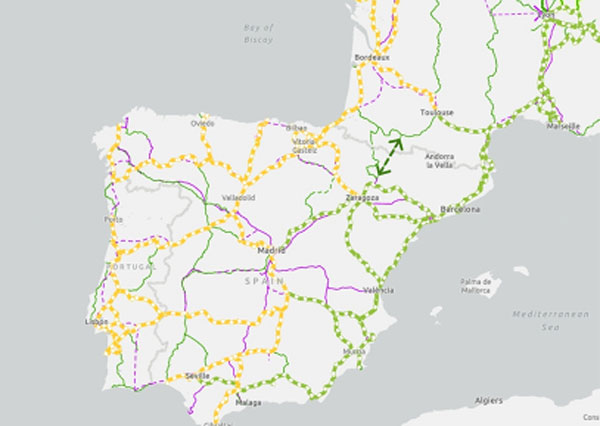
The Central Pyrenees Crossing (TCP) is conceived as a high-capacity trans-European rail corridor, designed to alleviate the congestion of activities and traffic in large metropolitan areas and improve the territorial balance of transport. Its development would make it possible to promote strategic locations such as logistics platforms and dry ports, which act as essential nodes to organize and redistribute the flow of goods in the Iberian Peninsula. In addition, the project maintains its presence on European maps as a projected section, reflecting its persistent interest at the community level.
The MCT is not only considered as an infrastructure of interest for Aragon or Spain, but also as a key connection for the whole of Southwest Europe. Thanks to its route, it would link capitals, main ports and logistic nodes of the Peninsula with the great corridors of Northern and Eastern Europe. This capacity to articulate distant spaces and facilitate international transit would make the MCT a strategic gateway, especially relevant in a context in which the current Pyrenean passes, concentrated at the eastern and western ends, present capacity limitations.
The project is part of a multimodal approach that favors seamless connections between ports, inland logistics platforms and long-distance rail networks, allowing the most efficient mode of transport to be chosen in each case.
In this way, the MCT would help to significantly increase the share of goods transported by rail, a priority objective for the European Union due to its contribution to decarbonization and the reduction of heavy road traffic. Its function as a multifunctional corridor would also allow the integration of an electrical interconnection channel, improving the stability and resilience of the energy network between both sides of the Pyrenees.
In addition to its economic and logistical dimension, the MCT has a clear strategic component linked to security and defense. The possibility of providing the corridor with dual civilian and military use fits with the growing European concern to strengthen its critical infrastructures in the face of geopolitical risks and threats to territorial integrity. Strengthening this type of rail connection reinforces the EU’s internal cohesion and helps to prevent fragmentation dynamics by ensuring that peripheral regions remain integrated into the continent’s major mobility and strategic response axes.
In 2009 Spain and France formed the European Economic Interest Grouping for the Central Pyrenees Crossing with legal capacity to obtain European aid and promote the necessary reports and preliminary work to develop the PCT.
At present, the EEIG has completed the studies foreseen in the initial development phase of the project from 2016 to 2020 and the content of the studies to be included in the next phase for the period from 2021 to 2027 is being prepared.
In 2021, the term of the EEIG was extended for an additional five years.


